Genogram Symbols
What do genogram symbols mean?
Genogram symbols work in three layers: shapes name each person, connecting lines show couples and children, and emotional lines drawn over the top show how those people actually get along.
- Square is male, circle is female, diamond is unknown; an X means deceased.
- Solid line is marriage, dashed is engagement or cohabiting, one slash separated, two divorced.
- Two parallel lines mean close, three mean fused, a jagged line means conflict.
- The standard comes from Monica McGoldrick, the notation most programs teach.
See the full key below, or draw them in the free genogram maker.
A genogram is read in three passes. First the shapes: a square is male, a circle is female, and whoever the diagram centers on wears a doubled outline. Then the connecting lines — solid, dashed, slashed — that tie partners together and drop down to their children. Last, the layer most people miss on a first look: the emotional lines drawn over the structure, where a jagged stroke between two people says far more than the marriage line beneath it. Decode those three layers and the whole map opens up.
This is the full reference, grouped the way it is taught — people, couple bonds, children, emotional ties, pregnancy, medical markers, and the structural marks for dates and households. The notation follows Monica McGoldrick's Genograms: Assessment and Intervention, the standard text behind nearly every counseling, social work, MFT, and psychiatric nursing program. Scan the key to decode a diagram or settle a symbol mid-assignment, or draw the people, couple lines, and emotional relationships on a canvas in the free genogram maker.
Where students lose marks
Four mistakes show up again and again in graded genograms, and a supervisor catches all of them in seconds:
- Drawing the partners in the wrong order. By convention the male partner sits on the left, the female on the right, with the oldest child nearest the left and younger siblings fanning right. Reverse it and a reader has to second-guess every node.
- Changing a shape to mark a death. A deceased person keeps their square or circle. You add an X through it and the death year at the top right — the shape never turns into anything else.
- Confusing the two kinds of dashed line. A dashed horizontal line between partners means cohabitation; a dashed emotional line means a distant relationship. Same dash, two unrelated meanings — the position on the page is what tells them apart.
- Shading for illness without a legend. A filled or quartered symbol means nothing on its own. Every color or fill needs a key on the page that says which condition it stands for.
Symbols marked In the tool can be drawn in the free genogram maker. The rest are standard notation you will meet in textbooks and case files, but the maker cannot draw them yet.
People
A male family member. Drawn as a square.
Square. Age centred inside; name/notes below.
A female family member. Drawn as a circle.
Circle. Age centred inside; name/notes below.
A person whose sex is unknown (e.g. an unborn child, or unrecorded ancestor).
Diamond.
The identified patient / client the genogram is centred on. Marked with a doubled outline.
Draw the person's shape with a second outline just inside it.
A person who has died. An X is drawn through the symbol; death year noted top-right.
Place an X inside/through the person's shape.
Couple relationships
A married couple. Solid line down from each partner and across; partner on the left is conventionally male. Marriage year noted on the line (m. YYYY).
Solid line linking the two partners.
An engaged couple, not yet married.
Dashed line linking the partners.
Partners living together but not married. Drawn as a dashed line (date noted).
Dashed connecting line.
A separated (but not divorced) couple. One slash through the union line.
Union line with a single diagonal slash; 's. YYYY'.
A divorced couple. Two slashes through the union line.
Union line with two diagonal slashes; 'd. YYYY'.
A short or extramarital relationship.
Dotted connecting line.
Children
A couple's biological child. Solid vertical line from the union to the child; children ordered oldest (left) to youngest (right).
Solid line down from the sibling line to the child.
An adopted child. Dashed vertical line to the child.
Dashed line down to the child.
A foster child. Dotted vertical line to the child.
Dotted line down to the child.
Non-identical twins. Two lines from a single point on the sibling line.
Two converging lines to one point on the sibling line.
Identical twins. As fraternal twins, joined by a horizontal bar.
Two converging lines joined by a connecting horizontal bar.
Emotional relationships
A close relationship. Two parallel lines between the two people.
Two parallel lines.
An enmeshed or fused relationship. Three parallel lines.
Three parallel lines.
An emotionally distant relationship. A single faint/dashed line.
Single thin or dashed line.
A conflictual relationship. A jagged (zigzag) line.
Jagged / zigzag line.
Simultaneously very close and conflictual. Parallel lines overlaid with a zigzag.
Two/three parallel lines with a zigzag drawn over them.
An emotional cutoff — contact broken off. A line interrupted by two short perpendicular bars.
Straight line broken by two perpendicular bars (gap).
One person over-focused on another (positive, negative, or mixed). Shown with a directional line.
Line with an arrowhead toward the focused-on person.
Physical, emotional, or sexual abuse from one person toward another (modern McGoldrick notation).
Jagged directional arrow from the abuser toward the abused person.
Pregnancy & loss
A current pregnancy. Drawn as a triangle.
Triangle on the sibling line.
A spontaneous pregnancy loss. Small solid (filled) circle.
Small filled circle on the sibling line.
An induced termination. Drawn as a small X (often on a short line).
Small X; for a female pregnancy a circle above the X.
A baby stillborn. The person shape (square/circle) with an X inside.
Slightly smaller person shape containing an X.
Medical & genetic
An illness or inherited condition is shown by filling or shading the person symbol with a colour defined in the genogram's legend.
Fill the symbol (or a portion of it) with the legend colour.
When a person has more than one tracked condition, divide the symbol into quadrants, each shaded for a different condition.
Split the symbol into quadrants; shade each per the legend.
Structure & dates
A dotted line encircling the people who currently live together as one household.
Dotted enclosure around co-residing members.
Birth year top-left, death year top-right of a symbol; current age centred inside.
b. YYYY (top-left), d. YYYY (top-right), age inside.
Watch the symbols drawn (24 seconds)
Squares, circles, and the relationship lines placed on a live canvas — the notation above, in motion.
Free chart: the symbols key & legend on one page
The whole reference above, condensed to a single A4 sheet — every person shape, every relationship symbol from marriage to cut-off, and the medical markers, each with its meaning. Print it, pin it next to your diagram, or drop it into course material.
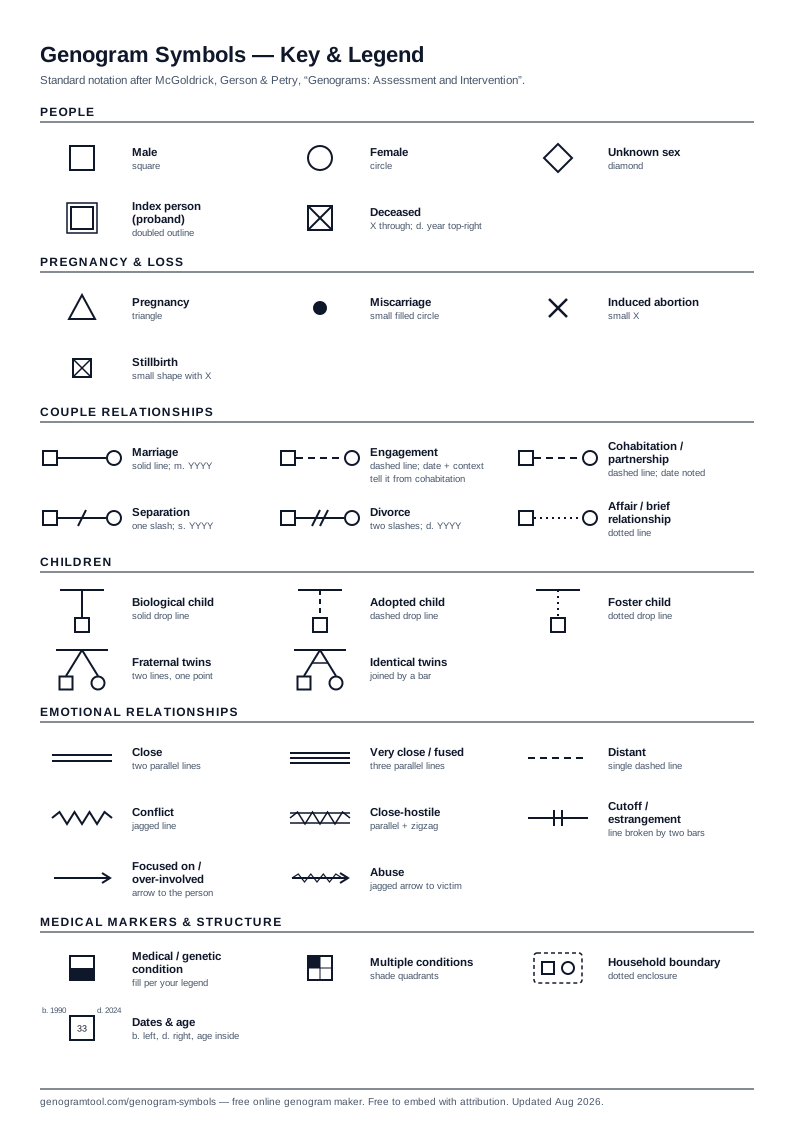
Embed this chart
Free to embed in course pages and articles with the attribution link. Copy the snippet below and paste it into your page:
Reading the key is one thing. Drawing it is faster.
The symbols marked “In the tool” are wired into the canvas — pick a shape, connect two people, mark the emotional ties, and export a clean PDF or PNG ready to hand in or drop into a case file. The rest, such as pregnancies, twins, or illness shading, are reference notation for now.
Open the genogram makerKeep reading
- Genogram key — the symbols and legend in a compact, printable reference.
- Genogram examples — the notation used in real three-generation diagrams.
- How to make a genogram — build one step by step.
- Emotional relationship lines explained — close, distant, conflict, cut-off, and fused in depth.
Frequently asked questions
- What are the basic genogram symbols?
- A male is drawn as a square, a female as a circle, and a person of unknown sex as a diamond. The identified patient (the person the genogram centers on) gets a doubled outline, and a deceased person has an X through their symbol. Age is written inside the symbol; birth and death years sit above it.
- What do the lines between people mean?
- Horizontal lines connect couples: a solid line is marriage, a dashed line is engagement or cohabitation, one diagonal slash means separation, and two slashes mean divorce. Vertical lines drop down to children — solid for a biological child, dashed for adopted, dotted for foster. Dates sit on the line itself: m. for the marriage year, s. for separation, d. for divorce.
- What are the emotional relationship symbols?
- Emotional (Bowenian) relationships are drawn as colored lines between two people: two parallel lines for close, three for fused, a single faint dashed line for distant, a jagged line for conflict, and a line broken by two short bars for an emotional cut-off.
- Is there a standard for genogram symbols?
- Yes. The widely used standard comes from Monica McGoldrick's Genograms: Assessment and Intervention. The symbols on this page follow that standardized notation, which is what social work, counseling, and family-therapy programs teach.
- Is there a printable genogram symbols chart or PDF?
- Yes. This page has a free one-page chart with every symbol and its meaning — the key and legend on a single A4 sheet. Open the printable version and use your browser's print dialog to print it or save it as a PDF, or download the chart as an SVG file.
- Can I use the genogram symbols chart in a course page or article?
- Yes, the chart is free to embed with attribution. Copy the embed snippet on this page — it loads the chart from genogramtool.com and links back to this symbols guide as the source.
- How do I show a deceased person on a genogram?
- Draw an X through the person's existing symbol — the square stays a square, the circle stays a circle — and write the year of death at the top right. Birth year goes top left, current age (or age at death) inside. The shape never changes; the X and the death year are the only marks you add.